

Over eighty percent of american shoppers say they are more likely to buy when stores offer smart product recommendations. With online competition rising, finding ways to personalize each shopping experience is key for any retailer who wants to stand out. This guide reveals practical data driven tactics that help american businesses uncover hidden opportunities in their sales data, implement advanced AI tools, and create product suggestions that truly resonate with every customer.
Table of Contents
- 1. Analyze Your Sales Data for Product Pairings
- 2. Leverage AI Tools for Automated Product Suggestions
- 3. Create Bundled Offers Based on Customer Insights
- 4. Highlight Frequently Bought Together Products
- 5. Set Up Cross-Sell Recommendations at Checkout
- 6. Personalize Product Picks with Customer Segmentation
- 7. Measure and Refine Product Recommendation Performance
Quick Summary
| Key Insight | Explanation |
|---|---|
| 1. Analyze sales data for product pairings | Use transaction records to identify products frequently bought together for targeted marketing strategies. |
| 2. Leverage AI for personalized recommendations | AI tools enhance customer experience by suggesting products based on behavior patterns and preferences. |
| 3. Create targeted product bundles | Combine complementary items based on purchasing patterns to increase average order value and customer satisfaction. |
| 4. Highlight frequently bought together products | Use data analysis to showcase relevant product suggestions that enhance the customer shopping experience. |
| 5. Continuously measure recommendation performance | Regularly track and refine recommendation metrics to improve personalization and increase conversion rates. |
1. Analyze Your Sales Data for Product Pairings
Unlocking the power of your sales data can transform how you approach product recommendations. Product pairing analysis reveals hidden connections between items customers frequently purchase together, enabling smarter cross selling strategies.
At its core, product pairing analysis examines transaction records to identify statistically significant product relationships. By studying which items are commonly bought in the same purchase, you can uncover patterns that might not be immediately obvious. Imagine discovering that customers who buy running shoes often purchase specialized athletic socks or hydration supplements.
Key Metrics to Examine:
- Support: How frequently products appear together in transactions
- Confidence: Percentage of transactions where paired products occur
- Lift: Statistical measure of how much more likely products are purchased together compared to random chance
To start, gather your sales data and use SQL or spreadsheet tools to run a basic analysis. Look for products with high confidence and lift metrics which indicate strong purchasing correlations. These insights can guide bundle offers, product placement strategies, and personalized recommendation algorithms.
Practical Implementation Steps:
- Export your complete sales transaction history
- Identify top product pairs with statistical significance
- Create targeted marketing campaigns highlighting these pairings
- Design product bundles or recommendation widgets based on discovered connections
Successful e commerce data analysis transforms raw numbers into actionable revenue strategies. Your sales data contains a treasure map of potential growth opportunities waiting to be unlocked.
2. Leverage AI Tools for Automated Product Suggestions
Artificial intelligence is revolutionizing how online stores recommend products, transforming customer experiences through intelligent, personalized suggestions. AI powered product recommendations can dramatically increase conversion rates and average order value by understanding individual customer preferences.
Modern AI recommendation engines use sophisticated machine learning algorithms to analyze customer behavior patterns. These tools track browsing history, past purchases, and interaction data to generate highly targeted product suggestions that feel intuitive and relevant.
How AI Recommendation Tools Work:
- Collect and analyze individual user behavior data
- Build personalized customer profiles
- Generate real time product recommendations
- Continuously learn and improve suggestion accuracy
Platforms like AI powered recommendation systems can automatically identify complex purchasing patterns humans might miss. For instance, a customer who buys hiking boots might receive recommendations for moisture wicking socks, lightweight backpacks, or trail maps.
Practical Implementation Strategies:
- Select an AI recommendation tool compatible with your e commerce platform
- Configure initial recommendation settings
- Connect your product catalog and customer data
- Monitor performance metrics and adjust algorithms
By embracing AI recommendation technologies, online stores can create more engaging shopping experiences that feel personal and intuitive to each customer.
3. Create Bundled Offers Based on Customer Insights
Creating intelligent product bundles is more than just randomly grouping items together. Product bundling strategies transform how online stores increase average order value by understanding deep customer purchasing patterns.
Successful bundling requires analyzing transaction data to identify natural product associations. Imagine discovering that customers who purchase running shoes frequently buy performance socks and energy supplements. These insights allow you to craft bundles that feel intuitive and valuable to shoppers.
Key Bundle Development Principles:
- Analyze historical transaction data
- Identify statistically significant product correlations
- Create offers that solve customer needs
- Price bundles attractively
Customer segmentation plays a crucial role in developing targeted bundles. Different customer groups might have unique preferences. A fitness enthusiast bundle will look entirely different from a home office productivity bundle.
Strategic Bundling Steps:
- Extract comprehensive sales transaction data
- Use statistical analysis to find product relationships
- Calculate bundle pricing for maximum attractiveness
- Test different bundle configurations
- Monitor customer response and adjust
Profitable bundles require deep understanding of customer purchase behaviors. By transforming raw data into intelligent product combinations, you create offers that feel personalized and compelling.
4. Highlight Frequently Bought Together Products
Revealing product associations transforms how customers discover complementary items in your online store. Cross selling strategies help shoppers find products that naturally enhance their initial purchase, increasing both customer satisfaction and store revenue.
Frequently bought together recommendations leverage transaction data to showcase intelligent product pairings. Think of it as a digital sales assistant quietly suggesting perfect companion products based on sophisticated purchase pattern analysis.
Key Recommendation Criteria:
- Statistical purchase frequency
- Product category compatibility
- Complementary functional value
- Customer segment preferences
Successful product highlighting requires deep data analysis. Machine learning algorithms can track thousands of transaction records to identify nuanced relationships humans might overlook. For instance, a customer buying running shoes might see recommendations for moisture wicking socks, performance insoles, or hydration supplements.
Strategic Implementation Steps:
- Collect comprehensive sales transaction data
- Analyze product purchase correlations
- Design visually compelling recommendation widgets
- Place recommendations strategically on product pages
- Continuously refine suggestion algorithms
By understanding product pairing dynamics, online stores can create shopping experiences that feel personalized and intuitive.
5. Set Up Cross-Sell Recommendations at Checkout
The checkout page represents a golden opportunity to strategically increase order value through intelligent product suggestions. Cross selling strategy transforms the final purchase moment into a personalized shopping experience that benefits both customers and online stores.
Checkout recommendations work by presenting complementary or related products precisely when customers are most receptive. These suggestions should feel helpful rather than intrusive, solving potential customer needs or enhancing their original purchase.
Strategic Recommendation Placement:
- Right before payment confirmation
- Adjacent to shopping cart summary
- Visible but not overwhelming
- Contextually relevant to cart contents
Successful cross sell recommendations rely on sophisticated data analysis. Machine learning algorithms can quickly assess a customers cart contents and suggest products with high probability of interest. For instance, someone buying a camera might see recommendations for memory cards, camera bags, or photography accessories.
Implementation Steps:
- Analyze historical transaction data
- Identify statistically significant product associations
- Design unobtrusive recommendation widgets
- Configure smart matching algorithms
- A/B test recommendation placements
By maximizing average order value through intelligent checkout suggestions, online stores can create win win experiences that delight customers and boost revenue.
6. Personalize Product Picks with Customer Segmentation
Customer segmentation transforms generic shopping experiences into laser targeted recommendations that feel individually crafted. Customer segmentation strategies enable online stores to move beyond one size fits all approaches and create meaningful connections with different consumer groups.
Sophisticated segmentation goes far beyond basic demographic information. Modern approaches analyze behavioral patterns, purchase histories, browsing interactions, and predictive modeling to understand nuanced customer preferences.
Powerful Segmentation Dimensions:
- Purchase frequency
- Average order value
- Product category preferences
- Engagement levels
- Price sensitivity
- Seasonal buying patterns
Effective personalization requires intelligent data analysis. Artificial intelligence can rapidly process complex customer data to generate granular segments that predict future purchasing behaviors. For example, a fitness enthusiast segment might receive different recommendations compared to a budget conscious home decorator.
Strategic Implementation Framework:
- Collect comprehensive customer interaction data
- Define meaningful segmentation criteria
- Develop targeted recommendation algorithms
- Create personalized communication strategies
- Continuously refine segmentation models
By understanding customer segmentation types, online stores can create shopping experiences that feel uniquely tailored to individual preferences.
7. Measure and Refine Product Recommendation Performance
Constant measurement and optimization separate successful online stores from average performers. Sales data analysis techniques help transform raw recommendation metrics into actionable strategies for continuous improvement.
Product recommendation performance goes beyond simple click through rates. Advanced tracking involves understanding nuanced customer interactions, conversion impact, and long term revenue generation from each recommendation strategy.
Key Performance Metrics:
- Recommendation click through rate
- Conversion rate of recommended products
- Average order value increase
- Revenue per recommendation
- Customer engagement scores
Effective performance measurement requires implementing robust A/B testing frameworks. By systematically comparing different recommendation approaches, stores can incrementally improve their personalization algorithms and understand precise customer preferences.
Strategic Refinement Process:
- Establish baseline recommendation performance
- Design controlled experimental variations
- Collect comprehensive interaction data
- Analyze statistical significance of results
- Implement winning recommendation strategies
- Continuously monitor and iterate
By mastering RFM analysis, online stores can transform recommendation performance from guesswork into a precise, data driven science.
Below is a comprehensive table summarizing key strategies and implementation steps from the article on enhancing product recommendations in e-commerce through data analysis, AI tools, and strategic bundling.
| Strategy | Implementation | Expected Results |
|---|---|---|
| Analyze Sales Data | Use SQL/spreadsheets to find high-confidence product pairs. | Discover hidden product pairings for better cross selling. |
| Leverage AI Tools | Implement AI recommendation engines to track behavior and suggest products. | Increase conversion rates and personalize shopping experiences. |
| Create Bundled Offers | Analyze data to identify natural product associations; create bundles based on these insights. | Boost average order value and meet customer needs. |
| Highlight Frequently Bought Together Products | Employ machine learning to find and display complementary products. | Enhance customer discovery and satisfaction, increase revenue. |
| Set Up Cross-Sell Recommendations at Checkout | Use data to suggest related products at checkout with minimal intrusion. | Increase average order value and improve customer experience. |
| Personalize Product Picks | Segment customers using behavior and purchase data for tailored recommendations. | Improve customer engagement and loyalty with targeted offers. |
| Measure and Refine Recommendations | Conduct A/B testing to optimize recommendation strategies. | Drive continuous improvement in recommendation effectiveness. |
Unlock the Power of Smart Product Recommendations to Grow Your Store
Many e-commerce owners struggle with turning sales data into clear, actionable strategies that boost average order value and improve customer experience. This article highlights the challenge of identifying valuable product pairings and personalizing recommendations to increase revenue without guesswork. Common pain points include understanding complex purchase patterns, creating effective bundles, and delivering relevant cross-sell suggestions that feel natural, not intrusive.
At APUS NEST we understand these challenges and offer a powerful SaaS platform that helps you uncover hidden revenue from your store’s sales data. Using advanced market basket analysis powered by AI, our tools analyze transaction records to reveal statistically significant product relationships. This means you can easily spot what your customers frequently buy together, develop precise cross-selling strategies, and personalize product bundles that truly resonate.
Benefits you gain include:
- Actionable reports highlighting the best product pairings to increase average order value
- Seamless data upload via CSV or integrations with Shopify and WooCommerce
- Freedom to export raw data and insights with no subscription needed
Harnessing these insights helps solve the very pain points discussed in the article, such as sophisticated product bundling and creating personalized shopping experiences that convert.
Discover how to transform your e-commerce growth with smart data-driven product recommendations today.
Ready to unlock your store’s hidden revenue potential with proven AI-powered product pairing insights?
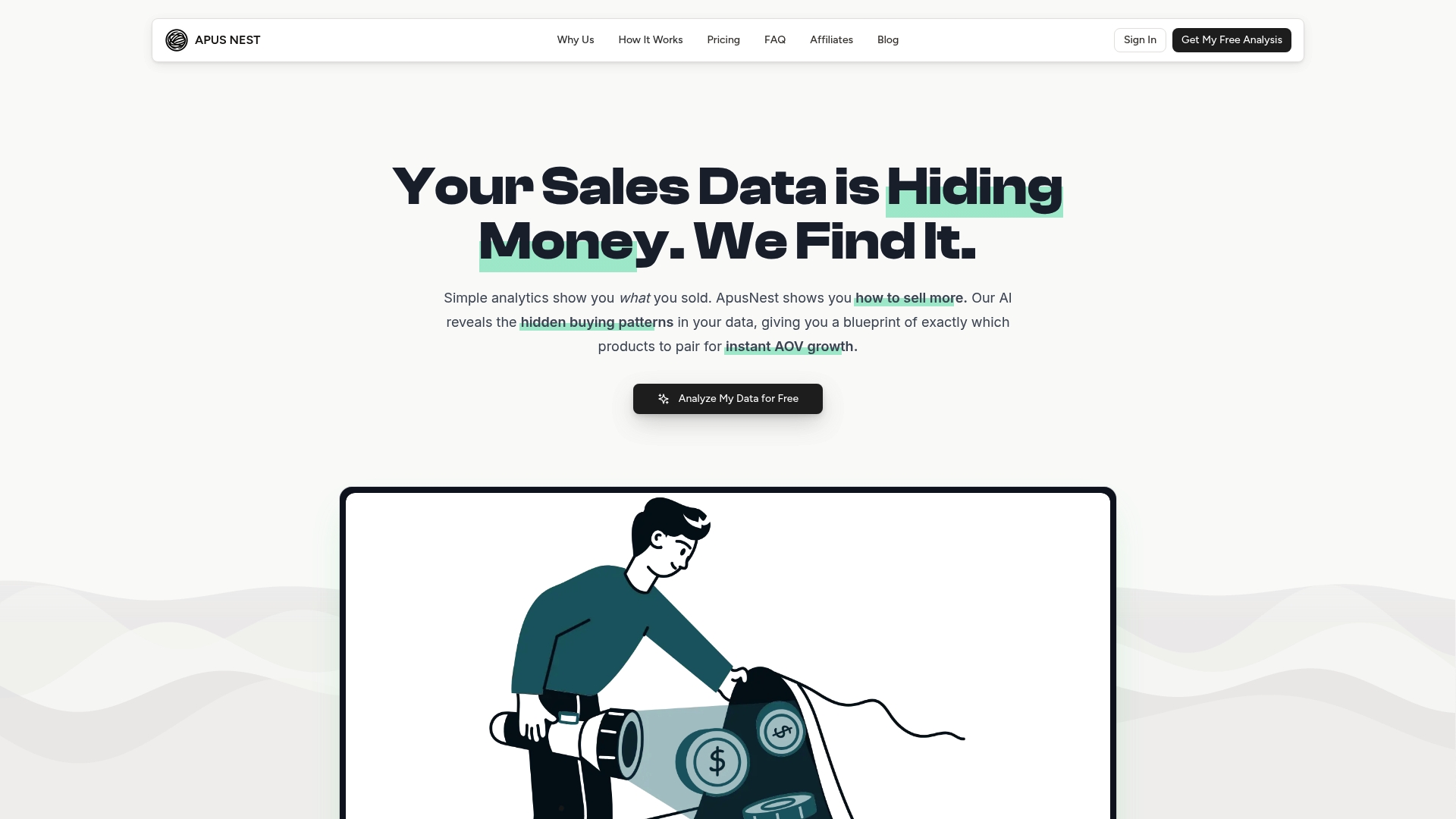
Get started now with APUS NEST and take control of your revenue growth. Visit apusnest.com to upload your sales data and receive your comprehensive product recommendation report. Explore our market basket analysis tools and dive deeper into strategies for maximizing average order value. Don’t wait to turn your data into your most powerful growth asset.
Frequently Asked Questions
How can I analyze my sales data for product pairing opportunities?
To analyze your sales data for product pairings, start by exporting your complete sales transaction history. Use tools like SQL or spreadsheets to identify items frequently purchased together, focusing on metrics like support, confidence, and lift, which can reveal strong product correlations.
What are the benefits of using AI tools for product recommendations?
AI tools automate product suggestions by analyzing customer behavior patterns, leading to more accurate and personalized recommendations. Implement an AI recommendation system to boost your conversion rates and average order value by customizing suggestions to individual customer preferences.
How should I create bundled offers based on customer insights?
To create effective bundled offers, analyze your transaction data to identify meaningful product associations. Once you’ve determined natural product relationships, craft bundles that address customer needs and price them attractively to encourage purchases.
What steps should I follow to implement cross-sell recommendations at checkout?
To implement cross-sell recommendations at checkout, analyze historical transaction data to identify product associations, then design unobtrusive recommendation widgets. Place these suggestions strategically on the checkout page to enhance the customer experience without overwhelming them.
How can I personalize product recommendations through customer segmentation?
Personalizing product recommendations involves defining meaningful customer segments based on behavioral patterns and preferences. Collect comprehensive customer interaction data and develop targeted algorithms to tailor suggestions uniquely for each segment, enhancing the shopping experience.
What metrics should I monitor to measure the success of my product recommendations?
Key metrics for measuring product recommendation success include the click-through rate, conversion rate of recommended products, and average order value increase. Set up a system for continuous monitoring and iteration, aiming for measurable improvements such as a 10-15% boost in revenue per recommendation.
Recommended
- Smarter Sells Product Recommendations Ecommerce Guide - ApusNest Blog | ApusNest
- Cross Selling Strategies Guide to Boost Online Store Revenue - ApusNest Blog | ApusNest
- 10 Essential Tips for Boosting Online Sales - ApusNest Blog | ApusNest
- 7 Effective Ways to Maximize Revenue in E-commerce - ApusNest Blog | ApusNest
- 7 Key Digital Marketing Trends 2025 for Malaysian Buyers - Projector Display
- Rapid Insurance Product Innovation Guide for P&C Insurers - Digital Insurance Platform | IBSuite Insurance Software | Modern Insurance System
