

Over 60 percent of american online retailers say boosting average order value is their top priority, yet few know where to start. In the rapidly changing world of e-commerce, competition pushes businesses to fine tune every decision for more profit. This guide offers a proven roadmap to help american sellers turn scattered sales data into smarter strategies, uncover high value product pairings, and design bundles that drive real revenue growth.
Table of Contents
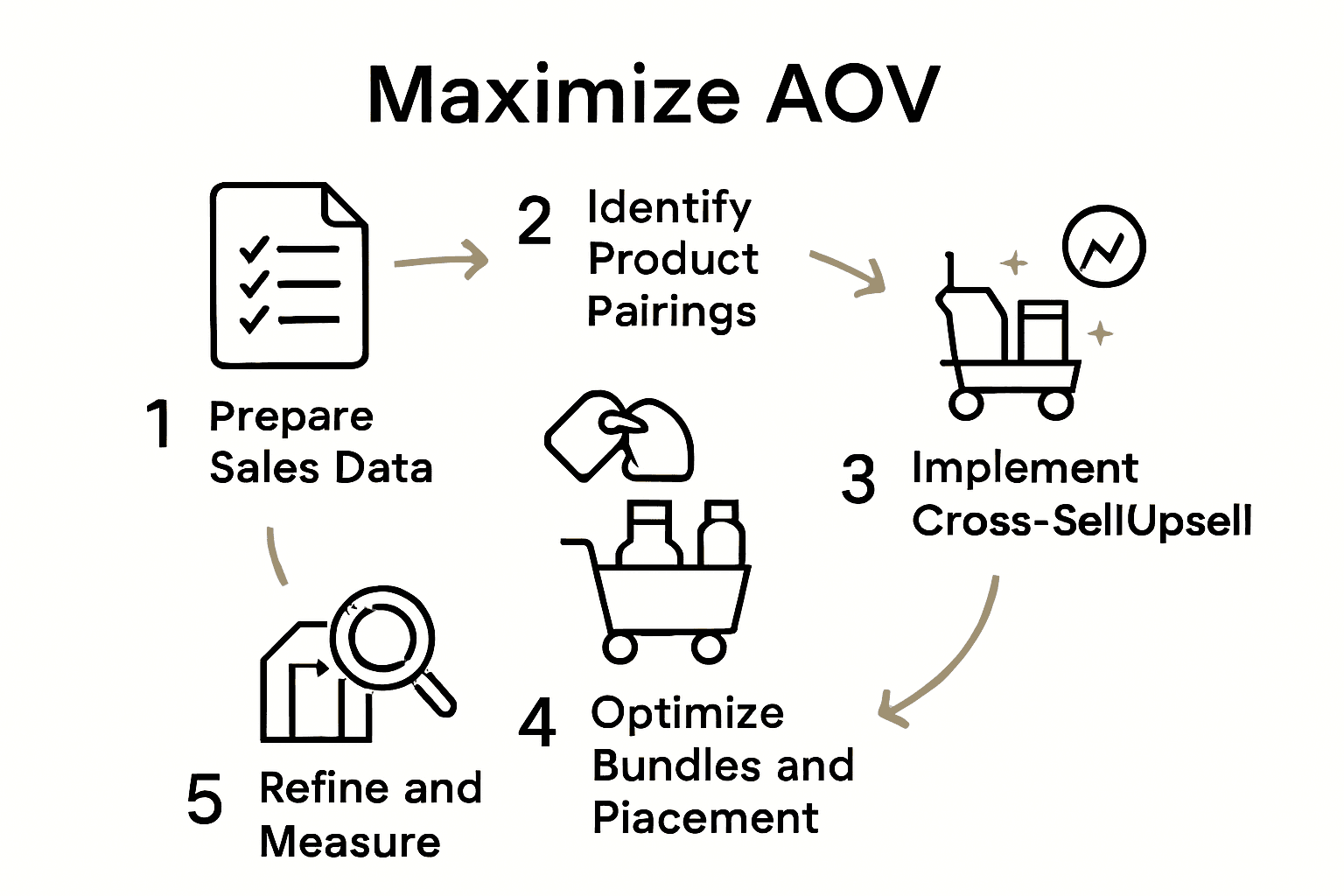
- Step 1: Prepare And Upload Sales Data For Analysis
- Step 2: Identify High-Potential Product Pairings Using Insights
- Step 3: Implement Targeted Cross-Sell And Upsell Strategies
- Step 4: Optimize Product Placement And Bundle Offers
- Step 5: Verify Improvements And Refine Based On Performance
Quick Summary
| Key Insight | Explanation |
|---|---|
| 1. Clean and Structure Data | Ensure your sales data is cleaned, normalized, and structured to enhance its interpretability and prepare it for analysis. |
| 2. Identify Product Pairings | Analyze sales data for frequently purchased product combinations to discover potentially profitable pairings for cross-selling. |
| 3. Implement Personalized Strategies | Use targeted recommendations based on customer behavior to create valuable upsell and cross-sell opportunities during the buying process. |
| 4. Optimize Bundling Techniques | Develop product bundle offers that pair complementary items and provide perceived value without significantly cutting profit margins. |
| 5. Continuously Evaluate Performance | Establish metrics to track the success of strategies and adapt based on performance data to drive ongoing revenue improvement. |
Step 1: Prepare and upload sales data for analysis
Successfully analyzing your e-commerce sales data starts with meticulous preparation and strategic data upload. This critical first step transforms raw transaction records into actionable insights that can dramatically improve your average order value.
Begin by collecting comprehensive sales data from your e-commerce platform, ensuring you export a complete CSV file containing essential transaction details. According to research from arxiv, proper pre-processing is fundamental for accurate sales demand forecasting. Focus on gathering key information such as product identifiers, order timestamps, customer details, product prices, and transaction quantities.
As you compile your dataset, prioritize data cleaning and normalization. Research indicates that careful feature selection and handling of missing values significantly enhances the interpretability of sales analysis arxiv. Remove duplicate entries, standardize formatting, and verify that each column represents consistent data types. Pro tip: Create a backup of your original dataset before making any modifications to preserve your raw information.
Once your data is cleaned and structured, navigate to the ApusNest upload interface. Select your prepared CSV file and review the preview to confirm all columns are mapped correctly. Check out our sales analysis guide for additional insights into optimizing your data preparation workflow. Your carefully prepared dataset is now ready for advanced market basket analysis and revenue optimization strategies.
Step 2: Identify high-potential product pairings using insights
Unlocking the most profitable product combinations requires a strategic approach that goes beyond simple guesswork. This step transforms raw sales data into a powerful roadmap for increasing your average order value by revealing hidden connections between products.
Behavioral analytics provides a sophisticated lens for understanding customer purchase patterns. According to research, this approach helps predict future buying behaviors by analyzing detailed interaction histories. Start by examining your sales data for recurring product combinations that customers frequently purchase together. Look for natural clustering patterns where specific items appear in the same transactions multiple times, indicating a potential complementary relationship.
To pinpoint high potential pairings, calculate the co-occurrence frequency of products across your entire sales dataset. Pay special attention to items that are purchased together but might not seem obviously related at first glance. Learn more about cross selling strategies for deeper insights into maximizing these opportunities. Pro tip: Focus on product pairs with high joint purchase rates and consider factors like price point, product category, and customer segment to validate the pairing potential. Your goal is to identify combinations that not only occur frequently but also make logical sense from a customer perspective.

Step 3: Implement targeted cross-sell and upsell strategies
Transforming your product insights into actionable revenue strategies requires a nuanced approach that goes beyond simple recommendations. This critical step turns your market basket analysis into a powerful mechanism for systematically increasing your average order value.
Marketing mix modeling provides a sophisticated framework for estimating the potential impact of different marketing tactics on product sales. Begin by segmenting your product pairings into strategic categories based on complementarity, price point, and customer purchase patterns. Design targeted recommendations that feel natural and valuable to your customers, focusing on creating a seamless shopping experience that anticipates their needs.
To refine your approach, explore our detailed cross selling strategy process for advanced implementation techniques. Virtual store research offers innovative methods for testing these strategies in simulated environments before full deployment. Pro tip: Develop personalized recommendation algorithms that consider individual customer history, ensuring each cross sell or upsell suggestion feels tailored and relevant. The most effective strategies create value for both the customer and your business by presenting genuinely useful product combinations that enhance the overall shopping experience.
Step 4: Optimize product placement and bundle offers
Maximizing your average order value requires strategic product positioning and intelligent bundling that transforms casual browsing into intentional purchasing. This step is about creating irresistible combinations that naturally encourage customers to spend more while feeling they are receiving exceptional value.
Virtual store research demonstrates the power of simulated retail environments in testing product placement strategies. By analyzing your sales data, create bundle offers that pair complementary products with thoughtful pricing strategies. Focus on creating combinations that solve customer problems or enhance product utility. Marketing mix modeling suggests examining historical sales data to identify the most compelling product relationships that drive increased purchase values.
Master product bundling strategies can help you refine your approach. Pro tip: Design bundles that offer a modest discount compared to purchasing items separately, creating a perception of value without significantly reducing your profit margins. The most successful bundles feel intuitive and solve real customer needs rather than appearing like forced sales tactics. Your ultimate goal is crafting product combinations that feel like personalized recommendations rather than generic upsells.
Step 5: Verify improvements and refine based on performance
The final stage of maximizing your average order value transforms data insights into continuous strategic improvement. This critical step ensures your marketing efforts evolve dynamically, turning initial strategies into a powerful revenue optimization engine.
Marketing mix modeling provides a systematic approach to measuring the impact of your implemented strategies. Start by establishing key performance indicators including average order value, conversion rates, and bundle purchase frequencies. Compare these metrics against your baseline measurements to quantify the tangible improvements generated by your cross sell and upsell initiatives. Virtual store research suggests creating controlled experiments that simulate different product placement and bundling scenarios to validate your approaches.
Pro tip: Develop a quarterly review process that goes beyond surface level metrics. Analyze not just overall performance but granular details like customer segment responses, seasonal variations, and product category specific trends. Your goal is building an adaptive system that continuously learns and optimizes itself. By treating performance verification as an ongoing dialogue with your data, you transform static strategies into living, breathing revenue generation mechanisms that consistently unlock hidden value in your e commerce ecosystem.
Unlock Your Store’s Hidden Revenue Potential Today
Are you struggling to increase your average order value despite your best efforts? The challenge of identifying the most profitable product pairings and turning them into effective cross-sell and upsell strategies can feel overwhelming. This article breaks down the critical steps like market basket analysis and strategic bundling that can transform your sales data into real growth.
At APUS NEST, we understand these pain points deeply. Our AI-powered platform takes the guesswork out of the process by analyzing your sales data to reveal hidden product relationships that boost your revenue. With easy CSV uploads and Shopify or WooCommerce integrations, our detailed reports provide actionable insights tailored specifically for your store’s needs. Say goodbye to generic recommendations and hello to personalized strategies that increase your AOV with confidence.
Ready to maximize your e-commerce growth by turning data into dollars? Visit APUS NEST now to start your free report and explore how our advanced market basket analysis can elevate your product placement, bundling, and marketing campaigns. Discover how simple it can be to unlock new revenue opportunities and watch your average order value climb.
Frequently Asked Questions
How can I prepare my sales data for analysis?
To prepare your sales data for analysis, start by collecting a complete CSV file from your e-commerce platform that includes essential details like product identifiers, order timestamps, and customer information. Make sure to clean the data by removing duplicates and standardizing formatting to ensure accuracy for further analysis.
What are effective strategies for identifying high-potential product pairings?
To identify high-potential product pairings, analyze your sales data for recurring combinations that customers frequently buy together. Focus on calculating the co-occurrence frequency of products; prioritize items that are often purchased together and consider logical relationships to enhance the effectiveness of your pairings.
How do I implement cross-sell and upsell strategies effectively?
To implement cross-sell and upsell strategies, segment your product pairings based on complementarity and customer purchase patterns. Create targeted recommendations that feel natural to customers, which can increase your average order value significantly.
What techniques should I use for optimizing product placements and bundle offers?
To optimize product placements and bundle offers, analyze your sales data to create bundles that pair complementary products with strategic pricing. Design bundles that offer value, such as a modest discount, which can drive more intentional purchases and lead to higher average order values.
How do I verify improvements in my average order value?
To verify improvements in your average order value, establish key performance indicators like conversion rates and bundle purchase frequencies. Regularly compare these metrics against your baseline to assess the effectiveness of your strategies and adapt based on performance data.
Recommended
- Increasing Average Order Value Steps: Boost Sales Effectively - ApusNest Blog | ApusNest
- Understanding AOV: Average Order Value Explained - ApusNest Blog | ApusNest
- 10 Essential Tips for Boosting Online Sales - ApusNest Blog | ApusNest
- Cross Selling Strategies Guide to Boost Online Store Revenue - ApusNest Blog | ApusNest
- Why Optimize Ecommerce Stores: Complete Guide – Shopify Experts: Grow Your eCommerce Revenue
- Maximize Conversions: E-Commerce Optimization Tips
