

Every e-commerce store collects an overwhelming amount of customer data. If you want to stand out, you need more than just numbers in a spreadsheet. Businesses that use RFM analysis have seen up to 15 percent higher customer retention rates compared to those who rely on generic metrics. Surprised? Most stores still treat all their customers the same. The real secret is that small shifts in how you group and target your customers can unlock major revenue gains.
Table of Contents
- Step 1: Identify Your Key Customer Data
- Step 2: Calculate RFM Scores For Your Customers
- Step 3: Segment Customers Based On RFM Scores
- Step 4: Develop Tailored Marketing Campaigns
- Step 5: Test Campaign Effectiveness And Adjust
- Step 6: Monitor And Refine RFM Strategy Over Time
Quick Summary
| Key Point | Explanation |
|---|---|
| 1. Collect Comprehensive Customer Data | Gather data from all platforms to gain a holistic view of customer interactions. |
| 2. Calculate Accurate RFM Scores | Use Recency, Frequency, and Monetary value to score customers effectively. |
| 3. Segment Customers Strategically | Create meaningful customer groups to tailor marketing efforts based on behaviors. |
| 4. Develop Targeted Marketing Campaigns | Create personalized campaigns for each segment to boost engagement and sales. |
| 5. Continuously Monitor and Adjust Strategy | Regularly review RFM segments and strategies to adapt to changing customer behaviors. |
Step 1: Identify Your Key Customer Data
Successful RFM analysis begins with comprehensive customer data collection. This foundational step transforms raw information into actionable insights that can dramatically reshape your e-commerce strategy. Your goal is to gather a holistic view of customer interactions that goes beyond basic transactional records.
To start, you’ll want to compile data from multiple sources within your e-commerce ecosystem. Your primary sources should include order management systems, payment platforms, website analytics, and customer relationship management (CRM) tools. Explore our customer insights analytics guide for deeper understanding of data integration techniques.
The most critical data points for RFM analysis include customer purchase dates, total transaction value, purchase frequency, product categories purchased, and customer lifetime duration. You’ll need precise timestamps for each transaction, not just dates. This granular approach allows for more nuanced segmentation and predictive analysis.
Data collection isn’t just about quantity but quality. Ensure data integrity by implementing consistent tracking methods across all platforms. This means standardizing how you record customer interactions, eliminating duplicate entries, and maintaining clean, structured datasets. Use unique customer identifiers that remain consistent across different platforms to create accurate customer profiles.
For most e-commerce businesses, the ideal data collection period spans 12 to 24 months. This timeframe provides sufficient historical context while remaining current enough to reflect recent customer behavior trends. Shorter periods might miss crucial seasonal variations, while longer periods could introduce outdated patterns that no longer represent your current customer base.
Verify your data collection process by cross-referencing information from multiple sources. Check that transaction values match across platforms, customer IDs are unique and consistent, and there are no unexplained gaps in purchase history. A clean, comprehensive dataset is the cornerstone of effective RFM analysis.
Here is a summary table of key customer data sources, the type of data collected, and its purpose for RFM analysis.
| Data Source | Key Data Collected | Purpose in RFM Analysis |
|---|---|---|
| Order Management Systems | Purchase dates, order details | Tracks transaction recency and frequency |
| Payment Platforms | Transaction values | Determines monetary value accuracy |
| Website Analytics | Browsing and purchase behavior | Supplements frequency and recency data |
| CRM Tools | Customer profiles, purchase history | Ensures complete customer identification |
| Unique Customer Identifiers | Cross-platform tracking | Maintains consistent and clean datasets |
Step 2: Calculate RFM Scores for Your Customers
Calculating RFM scores is the mathematical heart of customer segmentation where you transform raw data into actionable customer insights. This step converts transaction history into a strategic roadmap for understanding customer value and behavior patterns. Learn more about effective customer segmentation strategies to complement your RFM analysis.
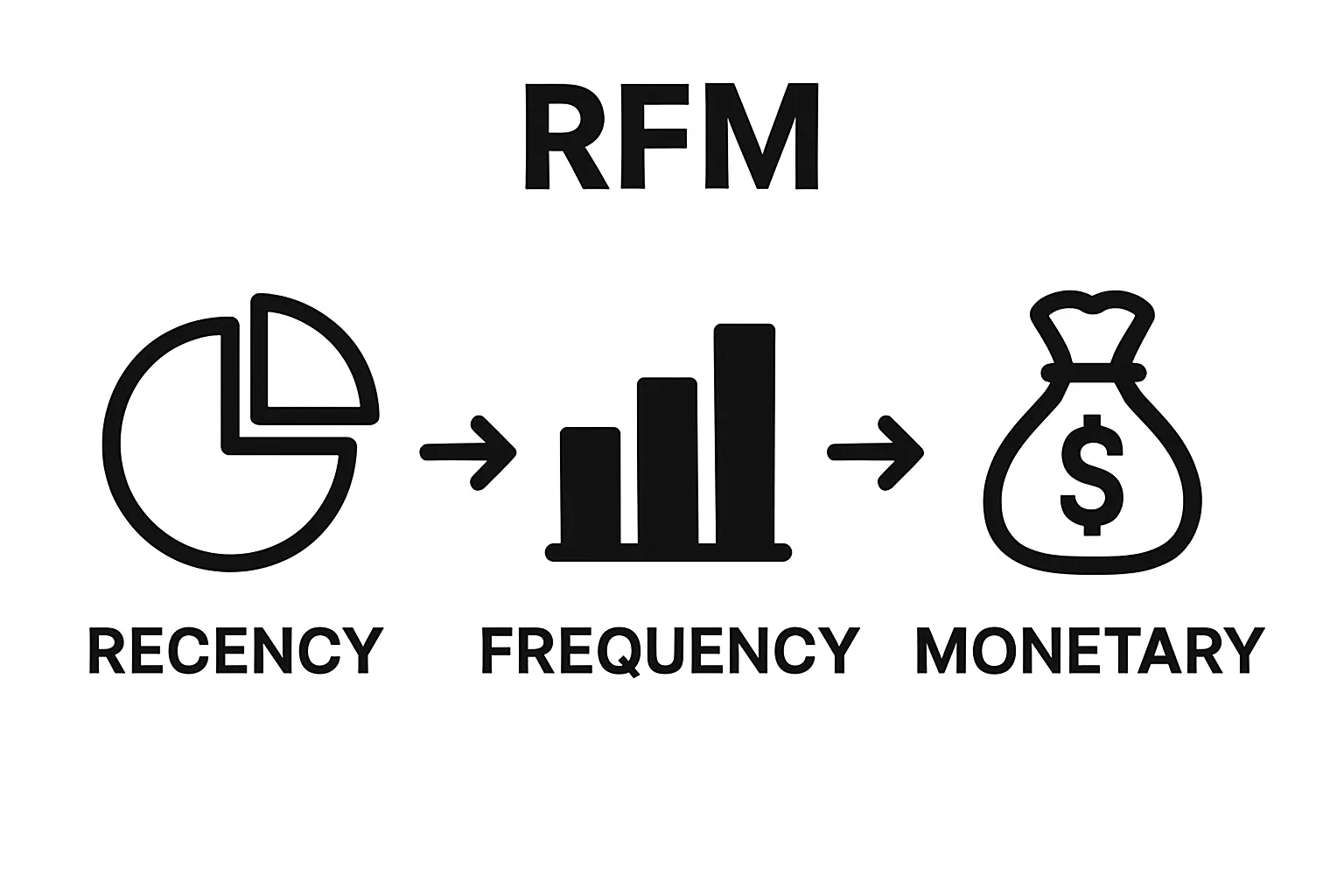
To calculate RFM scores, you’ll need to quantify three core dimensions: Recency, Frequency, and Monetary value. Start by establishing a consistent scoring framework where each dimension receives a numerical rating between 1 and 5. Recency measures how recently a customer made a purchase, with the most recent transactions scoring highest. Frequency tracks how often customers buy from your store, rewarding consistent purchasers with higher scores. Monetary value evaluates total spending, giving top scores to customers who contribute most to your revenue.
Recency calculation requires identifying the number of days between a customer’s most recent purchase and your analysis date. Customers who bought within the last 30 days receive a score of 5, while those with purchases over 120 days ago might score a 1. The frequency score depends on total transaction count during your analysis period. A customer with 10 purchases in 12 months would score higher than someone with only 2 purchases.
Monetary value scores reflect total customer spending. Divide your customers into quintiles based on total revenue generated, with top spenders receiving a 5 and lowest spenders getting a 1. This approach ensures your scoring adapts to your specific business context and revenue ranges.
Combine these individual scores to create a comprehensive RFM score. Multiply the three dimension scores to generate a composite rating between 1 and 125. Customers with scores near 125 represent your most valuable segments high-frequency, recent purchasers who spend significantly. Those with lower scores indicate potential churn risks or opportunities for targeted marketing.
Verify your RFM scoring by cross-checking calculations and ensuring logical progression in customer segmentation. A well-executed RFM analysis reveals nuanced customer behaviors that traditional metrics might overlook, transforming raw numbers into a strategic customer understanding framework.
Step 3: Segment Customers Based on RFM Scores
Customer segmentation transforms your raw RFM scores into strategic customer groups that drive targeted marketing and personalized experiences. The objective is to create meaningful customer clusters that reveal distinct behavioral patterns. Discover more customer segmentation strategies to enhance your approach.
Begin by creating five primary customer segments based on their composite RFM scores. Your champions are customers scoring between 81-125 these are your most valuable clients who purchase frequently, recently, and spend significantly. They represent your core revenue generators and deserve premium treatment. Your loyal customers, scoring between 61-80, are consistent buyers who make regular purchases but might not spend as much as champions.
Potential loyalists score between 41-60, representing customers with consistent purchasing patterns but lower overall monetary value. These customers have significant growth potential and require carefully crafted engagement strategies. At the lower end, customers scoring 21-40 are categorized as new customers or at-risk segments. These individuals have made minimal purchases or have longer gaps between transactions.
Customers scoring below 20 represent your hibernating or lost customer segment. For each group, develop targeted strategies that address their specific behavior. Champions might receive exclusive early access to new products, while potential loyalists could benefit from personalized discount offers that encourage higher spending.
To verify your segmentation, conduct a comprehensive review of each segment’s characteristics. Check that the total number of customers matches your original dataset, and ensure each segment has clear, distinguishable traits. According to research on customer clustering techniques, using advanced statistical methods can further refine these segments.
Effective segmentation goes beyond simple mathematical divisions. Consider the unique context of your e-commerce business, factoring in seasonal variations, product categories, and emerging customer trends. Your segmentation strategy should be dynamic, allowing for periodic reassessment and refinement as your customer base evolves.
This table highlights the primary RFM customer segments, their score ranges, and the main marketing strategies recommended for each group.
| Segment | RFM Score Range | Characteristics | Suggested Marketing Strategy |
|---|---|---|---|
| Champions | 81-125 | Recent, frequent, and high-spending customers | VIP experiences, exclusives, early access |
| Loyal Customers | 61-80 | Consistent buyers, less monetary value than champions | Personalized offers, loyalty programs |
| Potential Loyalists | 41-60 | Growing purchase patterns but spend less overall | Upselling, tailored discounts |
| At-Risk/New | 21-40 | Infrequent or recent, minimal purchase history | Re-engagement, welcome incentives |
| Hibernating/Lost | 0-20 | Long periods of inactivity or minimal spend | Win-back campaigns, strong incentives |
Step 4: Develop Tailored Marketing Campaigns
Tailored marketing campaigns transform your RFM analysis into targeted strategies that speak directly to each customer segment’s unique characteristics and behaviors. The goal is to create precision-targeted communications that maximize engagement and conversion potential. Explore advanced campaign analytics techniques to refine your approach.
For your champion customers scoring 81-125, design exclusive, high-value experiences that reinforce their premium status. These campaigns might include early product access, personalized VIP discounts, or invitation-only events that make them feel genuinely special. Craft messaging that acknowledges their consistent support and positions them as your most valued customers.
Loyal and potential loyal customers require nuanced strategies focused on incremental value growth. Develop cross-selling and upselling campaigns that introduce complementary products based on their previous purchase history. For instance, a customer who regularly purchases running shoes might be interested in premium athletic socks or performance tracking accessories. The key is creating recommendations that feel intuitive and genuinely beneficial rather than pushy.
Customers in lower scoring segments demand different engagement tactics. For at-risk or new customers, design re-engagement campaigns with compelling incentives. This could involve time-limited discounts, product bundles that lower initial purchase barriers, or educational content that demonstrates your brand’s unique value proposition. According to research on personalized marketing effectiveness, these targeted approaches significantly improve customer retention and conversion rates.
Verify your campaign effectiveness by establishing clear performance metrics for each segment. Track key indicators like open rates, click-through percentages, conversion rates, and incremental revenue generated. A successful tailored marketing approach should show measurable improvements in customer engagement and spending across different RFM segments. Remember that marketing campaigns are iterative processes continuous measurement and refinement are crucial to long-term success.
Step 5: Test Campaign Effectiveness and Adjust
Testing campaign effectiveness is the critical final step that transforms your RFM analysis from theoretical strategy to measurable business growth. Your goal is to systematically validate and refine marketing approaches across different customer segments. Learn advanced techniques for data-driven campaign optimization to enhance your analytical approach.
Implement A/B testing methodologies that compare different campaign variants within each RFM segment. Design controlled experiments where you modify specific elements like messaging, offer structure, or communication channels. For champion customers, test variations in exclusive offer language. For potential loyalists, experiment with different discount percentages or product bundle configurations.
Establish clear, quantifiable metrics that directly measure campaign performance. Key performance indicators should include conversion rates, average order value, customer acquisition cost, and segment-specific engagement levels. Track how different campaign variations impact these metrics across your RFM-defined customer groups. Look beyond surface-level metrics to understand deeper behavioral shifts and long-term value generation.
According to research on marketing experimentation, statistical significance is crucial when interpreting test results. Ensure your sample sizes are large enough to draw meaningful conclusions. Typically, aim for at least 95% confidence intervals when declaring a campaign variant as more effective. This approach prevents premature decisions based on random fluctuations.
Review test results comprehensively, understanding that success might look different for each customer segment. A campaign that marginally improves conversion for champions might represent a significant breakthrough for at-risk customers.
 Create a systematic feedback loop where insights from each test inform future campaign design. This iterative process transforms your marketing approach from static planning to dynamic, data-driven optimization.
Verify your testing process by maintaining detailed documentation of experiment parameters, results, and subsequent strategy adjustments. A robust testing framework doesn’t just improve immediate campaign performance it builds an organizational capability for continuous marketing innovation.

Step 6: Monitor and Refine RFM Strategy Over Time
Successful RFM analysis is not a one-time event but an ongoing strategic process that demands continuous attention and adaptation. Your RFM strategy must evolve alongside your business and customer behaviors. Explore advanced advertising analysis techniques to complement your monitoring approach.
Establish a quarterly review cycle where you comprehensively reassess your RFM segments and marketing strategies. During these reviews, analyze how customer behaviors have shifted, identifying emerging trends and potential segment migrations. Pay close attention to customers moving between segments, as these transitions provide crucial insights into changing purchasing patterns and overall customer lifecycle dynamics.
Track key performance indicators that reveal the health and effectiveness of your RFM strategy. Monitor metrics like customer retention rates, segment-specific conversion percentages, average order values, and the ratio of customers moving between different RFM categories. A robust monitoring approach helps you detect subtle shifts that might indicate broader market changes or emerging customer preferences.
According to research on customer data analysis, periodic segment recalibration is essential for maintaining strategic relevance. Consider adjusting your RFM scoring methodology if you notice significant deviations from expected customer behaviors. This might involve modifying score thresholds, introducing new segmentation criteria, or developing more nuanced categorization methods that reflect your evolving business landscape.
Implement a proactive feedback mechanism that allows for rapid strategy adjustments. This could involve creating cross-functional teams that review RFM insights quarterly, ensuring marketing, sales, and product development teams collaborate on interpreting and acting upon customer segmentation data. The goal is to transform RFM analysis from a static reporting tool into a dynamic strategic framework that drives continuous business improvement.
Verify the effectiveness of your monitoring process by documenting specific strategy changes implemented based on RFM insights. Maintain a clear record of how segment-specific observations translated into actionable business decisions, creating a comprehensive narrative of your data-driven strategic evolution.
Turn RFM Insights Into Real E-Commerce Growth With APUS NEST
You are ready to harness the power of RFM analysis to unlock hidden value in your store. But collecting data and generating RFM scores is only half the journey. Many e-commerce owners get stuck turning these numbers into real sales, actionable product pairings, and personalized campaigns that move the revenue needle. The truth is, without the right tools, finding the perfect cross-sell opportunities and optimizing average order value can feel overwhelming and costly.
Bridge the gap between analytics and revenue with APUS NEST. Upload your sales data or integrate your platform for instant market basket analysis powered by AI. See exactly which product combinations increase order value and receive tailored recommendations you can put to work today. Start for free to experience actionable insights and upgrade for access to full professional reporting and export options that amplify your marketing edge. Ready to see which combinations will drive your next wave of growth? Visit APUS NEST now to claim your free report and transform your RFM strategy into measurable results. For practical tips, check out our guide on customer insights analytics and feel confident pushing every segment of your customer base towards higher lifetime value.
Frequently Asked Questions
What is RFM analysis in e-commerce?
RFM analysis, or Recency, Frequency, and Monetary value analysis, is a marketing technique used to identify valuable customers based on their purchasing behavior. It helps e-commerce businesses segment their customer base for targeted marketing.
How do you collect data for RFM analysis?
To collect data for RFM analysis, gather customer information from order management systems, payment platforms, website analytics, and CRM tools. Key data points include purchase dates, transaction values, purchase frequency, and customer lifetime duration.
How do you calculate RFM scores?
RFM scores are calculated by scoring customers on three dimensions: Recency (how recent their last purchase was), Frequency (how often they purchase), and Monetary value (how much they spend). Each dimension is rated from 1 to 5, and combined scores form a comprehensive RFM score.
What types of marketing campaigns can be developed from RFM analysis?
Targeted marketing campaigns can be tailored based on RFM segments. For example, high-value customers may receive exclusive offers, while at-risk customers can be engaged with re-engagement campaigns, personalized discounts, and product recommendations.
Recommended
- 7 Effective Customer Segmentation Examples for E-commerce - ApusNest Blog | ApusNest
- Guide to E-Commerce Data Analysis for Increased Sales - ApusNest Blog | ApusNest
- Understanding Data Analysis for Marketers Guide - ApusNest Blog | ApusNest
- Maximize Sales with Content Marketing for Ecommerce
- 5 Ways To Increase Your eCommerce Conversion Rate - Paul Baguley
