

Finding the right insights from sales and customer data can open new possibilities for any online store. Whether you want to uncover hidden buying patterns, spot the perfect items to offer together, or understand your shoppers across different channels, the right solution makes a big difference. Some tools offer simple recommendations you can act on quickly, while others give you deep analysis across all your platforms. The question is which approach will help your business grow faster and make smarter decisions every day.
Table of Contents
apusnest
At a Glance
apusnest is an AI-powered market basket analysis platform built to help Shopify and WooCommerce merchants uncover hidden buying patterns and boost average order value (AOV). It delivers clear, actionable reports from uploaded CSVs or direct integrations (including Google Analytics GA4), and it balances a low-friction free option with deeper paid reports. If you want to turn transactional data into specific product-pairing and bundling recommendations without wrestling with raw SQL or complex BI tools, apusnest gets you there fast. Design choices favor practical, exportable insights over feature bloat.
Core Features
apusnest analyzes sales data using AI-driven market basket techniques to surface product associations, cross-sell opportunities, and bundling ideas. Integrations include Google Analytics (GA4), Shopify, and WooCommerce, while CSV upload supports detailed custom analysis when you need it. The platform produces insight reports with prioritized recommendations, and a real-time dashboard highlights key store metrics and trends so you can act quickly. Export capabilities let you move raw results into email, ads, or merchandising tools for execution.
Pros
- Provides deep insights into product purchase patterns, enabling you to identify high-impact pairings and sequence offers that increase AOV.
- Easy to connect with existing analytics tools and e-commerce platforms, including GA4, Shopify, and WooCommerce, which minimizes setup friction.
- Flexible pricing options including free reports and subscription tiers let stores test value before committing to recurring spend.
- Actionable AI-driven recommendations are presented in clear, prioritized formats so marketing and merchandising teams can implement changes quickly.
- Secure and transparent data handling, with exportable raw data and clear ownership rules, supports privacy-conscious merchants and downstream analysis.
Who It’s For
This is built for small-to-midsize e-commerce store owners, Shopify and WooCommerce merchants, and marketing teams that need practical, revenue-focused insights without hiring a data scientist. You should be someone who can export sales history or connect GA4/your store and wants targeted cross-sell, bundling, and placement strategies to move the needle on AOV. Data analysts who need quick, exportable association results will also find apusnest efficient and trustworthy.
Unique Value Proposition
apusnest combines focused AI market-basket modeling with real-world e-commerce integrations and export-first design. Unlike broad analytics suites that bury association signals in dashboards, apusnest translates patterns into prioritized, executable recommendations—paired items, bundle suggestions, and merchandising changes—so you can implement tests in days, not weeks. Its pricing structure is deliberately flexible: you can buy a one-time report, use a free basic analysis, or subscribe for continuous insights, which means stores pay only for the level of cadence they need. Transparency and data ownership are baked in: raw exports and clear handling policies remove vendor lock-in and support multi-channel execution. The platform intentionally favors actionable revenue outcomes over exhaustive features, making it a superior choice for merchants focused on AOV uplift and fast implementation.
Real World Use Case
A Shopify store uploads three months of sales CSVs (or connects directly), receives an apusnest product association report highlighting underutilized pairings and suggested bundles, then implements those bundles on product pages and in post-purchase offers. Within weeks, conversion-tested placements and targeted cross-sell campaigns drive measurable AOV growth and simplify inventory-focused promotions.
Pricing
Free tier available; one-time report for $39; subscription plans starting at $99/month for continuous insights.
Website: https://apusnest.com
DaaSity
At a Glance
DaaSity is an omnichannel analytics platform aimed at consumer brands that need enterprise-level insights without building a data engineering stack. It pulls ecommerce, retail, marketing, and inventory data into a unified view so teams can act quickly on pricing, promotions, and customer behavior. Bottom line: if you want consolidated, real-time visibility across channels to drive revenue and reduce operational friction, DaaSity delivers—though pricing and integration complexity may require a closer conversation.
Core Features
DaaSity connects multiple data sources including ecommerce storefronts, retail point-of-sale, marketing platforms, and inventory systems to create a single source of truth. The platform provides real-time analytics for sales, marketing, and inventory, tracks the customer journey from visit to checkout, and surfaces insights on pricing, promotions, product performance, and customer behavior. It also offers industry-tailored capabilities for categories like cosmetics, wellness, food & beverage, apparel, and home goods, enabling attribute-level analysis across geographies and channels.
Pros
- Unified data across channels: DaaSity consolidates ecommerce, retail, marketing, and inventory data into one view so your team can make cross-channel decisions without juggling spreadsheets.
- Real-time enterprise analytics without heavy engineering: The platform claims to remove the need for dedicated data engineering resources, enabling teams to access near-instant insights and act faster.
- Industry-specific support: With tailored solutions for categories such as cosmetics and apparel, DaaSity provides filters and metrics that map to retail use cases rather than a one-size-fits-all dashboard.
- Actionable merchandising and marketing insights: The product highlights pricing, promotions, and product performance so you can optimize assortment and campaign spend based on observed behavior.
- Retention and LTV focus: Built-in tracking of customer journeys helps teams design retention and repeat-purchase strategies that can increase lifetime value.
Cons
- Limited explicit transparency on drawbacks: The provided content does not detail specific limitations or performance ceilings, making it harder to assess edge-case risks.
- Integration effort may vary by setup: Depending on existing systems and data cleanliness, connecting multiple channels could require nontrivial implementation work and coordination.
- Pricing not disclosed: The lack of clear pricing information in the materials means you’ll need to engage sales to understand total cost and ROI timelines.
Who It’s For
DaaSity is best for consumer brands—both retail and ecommerce—that need centralized, enterprise-grade analytics but lack a large data engineering team. It suits merchants focused on optimizing pricing, promotions, inventory, and retention across multiple channels and regions.
Unique Value Proposition
DaaSity’s core promise is omnichannel, real-time analytics tailored to consumer brands that eliminates the need for heavy data engineering, letting commercial teams move from data collection to decision-making faster.
Real World Use Case
A fast-growing brand can use DaaSity to identify underperforming SKUs, adjust promotional mixes across channels, and refine pricing strategies—similar to how Blueland scaled by using analytics to uncover growth opportunities and operational efficiencies.
Pricing
Not explicitly specified in the provided content.
Website: https://daasity.com
Glew
At a Glance
Glew is an all-in-one commerce data platform that centralizes sales, customer, and inventory data and layers AI-driven insights on top of it. It’s designed to simplify the data journey from ingestion to reporting for medium and large retailers, with deep integration coverage and robust normalization. If you need a seriously capable analytics engine that can handle multi-brand and omni-channel complexity, Glew delivers — but it can feel heavy if you don’t have a data-focused team. Bottom line: powerful and reliable, with a learning curve and quote-based pricing to plan for.
Core Features
Glew unifies data from 170+ sources and applies advanced data warehousing and normalization so metrics are consistent across channels and brands. The platform offers powerful reporting and customizable dashboards, multi-brand aggregation, and a no-code report builder in Glew Pro and Plus tiers. Automated pipelines and validation reduce manual ETL work, and the system surfaces AI-driven insights and segments to help you act on customer behavior and inventory signals quickly.
Pros
- Centralizes all commerce data for easy access and analysis: Glew brings disparate sales, customer, and inventory feeds into a single dataset so you can analyze AOV, LTV, and SKU performance without stitching CSVs together.
- Supports extensive integrations, facilitating a cohesive data ecosystem: With 170+ connectors, it reduces the friction of pulling platform, ad, and POS data into one place.
- Provides automated data pipelines and validation for reliable insights: The platform’s automation minimizes broken feeds and inconsistent metrics, saving time on troubleshooting.
- Offers customizable reporting and dashboards tailored to business needs: The no-code report builder and dashboard configuration let you build KPIs that match your team’s workflows.
- Trusted by thousands of stores, indicating reliability and effectiveness: Glew’s customer base suggests maturity and stability in production environments.
Cons
- Complexity might be overwhelming for small or new businesses without dedicated data teams: The platform’s depth carries operational complexity that can require specialized staff to extract full value.
- Pricing details are available upon request, which could be a barrier for some small businesses without budget clarity or upfront pricing transparency: You’ll need to engage sales to understand total cost of ownership.
- Pricing structure is tailored and may require consultation for exact costs: This customization means budgeting can take longer and vary widely between merchants.
Who It’s For
Glew is best for medium to large eCommerce and retail businesses that operate multiple stores, brands, or channels and need a single source of truth for commerce data. If you run a team with analysts or a marketing ops lead who can act on segmented insights and build custom reports, Glew will scale with your needs. If you’re a solo founder or very small shop, it may be more than you require.
Unique Value Proposition
Glew’s strength is its end-to-end retail intelligence stack: broad connector coverage, solid data normalization, and no-code analytics combine to turn fragmented commerce signals into actionable, cross-channel insights. In short: it removes the plumbing so you can focus on growth strategies.
Real World Use Case
A multi-brand retailer consolidates sales, customer, and inventory feeds into Glew to create real-time dashboards, launch targeted acquisition and retention campaigns based on high-value segments, and optimize replenishment where SKU-level demand signals indicate stockouts or excess.
Pricing
Quote-based
Website: https://glew.io
marketbasket.io
At a Glance
Marketbasket.io is a focused market-basket analytics tool built for small and medium-sized businesses that need actionable cross-sell and bundling insights without enterprise complexity. It analyzes purchase data up to 100,000 transactions and 1,000 products per dataset, then reports association metrics like support, confidence, and lift to highlight meaningful product relationships. Affordable and user-friendly, it’s a practical choice when you want quick, exportable recommendations that your merchandising or marketing team can act on immediately.
Core Features
Marketbasket.io provides straightforward market basket analysis designed around the practical needs of SMBs: import-your-data workflows, computation of standard association measures (support, confidence, lift), and report exports in CSV or PDF for sharing or further analysis. The platform supports datasets up to 100,000 transactions and 1,000 products, has a simple, no-fuss interface tuned to retailers, and offers both monthly and yearly billing with a 24-hour free trial to test fit. The output focuses on product relationships and cross-sell opportunities rather than overwhelming you with vanity metrics.
Pros
- Affordable for smaller sellers: The pricing and plan structure is positioned to be more budget-friendly than enterprise analytics suites, making it accessible to SMBs with limited analytics spend.
- Easy to use with minimal setup: The interface and import process prioritize simplicity, enabling merchants to run analyses quickly without specialist support.
- Delivers actionable merchandising insights: By surfacing paired products and metrics like lift and confidence, it helps you decide which items to bundle, promote, or reposition.
- Exportable results for downstream use: CSV and PDF export options let you move findings into spreadsheets, POS uploads, or campaign briefs without re-keying data.
- Flexible subscription options: Month-to-month or annual billing gives you control, and the annual plan includes an incentive of two months free.
Cons
- Dataset limits constrain scale: The cap at 100,000 transactions and 1,000 products means the tool may not meet the needs of larger retailers or fast-scaling stores.
- Not built for enterprise workloads: Its design centers on smaller datasets and simpler workflows, so it lacks the heavy-duty scalability and customization enterprises often require.
- Requires basic data prep and knowledge: Users should be comfortable preparing transaction-level exports and interpreting association metrics, which means a small learning step before you get full value.
Who It’s For
Marketbasket.io is aimed squarely at small to medium-sized retailers, Shopify or WooCommerce merchants, and marketing teams that want to squeeze more revenue from existing SKUs without hiring data scientists. If you manage merchandising, run bundle promotions, or run a boutique catalog under 1,000 SKUs, this tool gives fast, practical insights you can implement in days.
Unique Value Proposition
The platform’s value is in making market-basket analytics approachable and affordable: it strips away enterprise complexity to deliver clear, exportable association results that directly inform bundling, placement, and cross-sell tactics. In short: purposeful analytics for merchants who prioritize action over noise.
Real World Use Case
A retail shop imports three months of POS transactions, identifies high-lift item pairs, and creates targeted bundle offers for those combinations. The store then promotes the bundles in email and on-site placement, seeing measurable uplift in average order value and improved customer satisfaction as complementary items are surfaced more clearly.
Pricing
Free trial available; monthly and yearly billing options exist, and annual subscriptions include two months free.
Website: https://marketbasket.io
E-commerce Analytics Tools Comparison
This table provides a concise comparison of various e-commerce analytics tools, highlighting their core features, pros, cons, pricing, and intended audience, to help merchants select the best solution for their needs.
| Tool | Core Features | Pros | Cons | Pricing |
|---|---|---|---|---|
| apusnest | AI-driven market basket analysis, integrations with Google Analytics, Shopify, WooCommerce | Deep insights into product patterns, easy integrations, flexible pricing | Limited to small-to-midsize businesses | Free tier; $39/report; $99/month |
| DaaSity | Omnichannel analytics, real-time data integration | Real-time insights without heavy engineering, industry-specific support | Integration complexity, no disclosed pricing | Pricing not specified |
| Glew | Centralizes sales, customer, and inventory data | Extensive integration, customizable reporting | Complex for small businesses, quote-based pricing | Quote-based |
| Marketbasket.io | Market basket analysis for SMBs, simple interface | Affordable, easy setup, actionable insights | Dataset limits, not for enterprise | Free trial; Monthly/Yearly plans |
Unlock Hidden Revenue with AI-Powered Market Basket Analysis
Ecommerce store owners know the struggle of turning raw sales data into clear, actionable strategies that boost Average Order Value (AOV). The article highlights the challenge of navigating complex analytics platforms to find meaningful product relationships and cross-sell opportunities that really move the needle. If you are a Shopify or WooCommerce merchant aiming to uncover those hidden pairing insights without technical headaches, apusnest is designed just for you. Our platform uses advanced AI market basket analysis to transform your sales data into prioritized, easy-to-understand reports that empower you to increase revenue through smart bundling and targeted product placements.
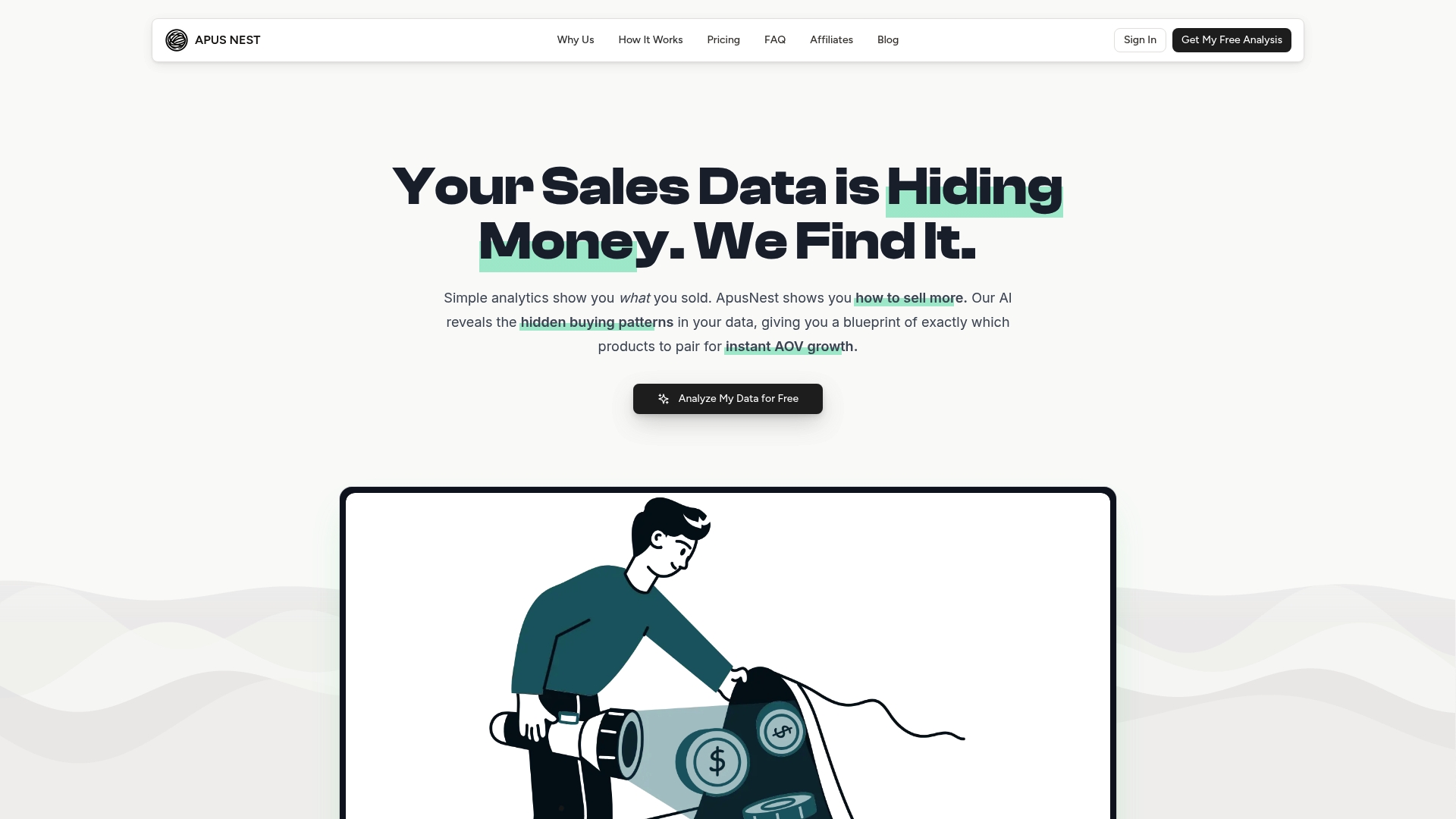
Take control of your ecommerce growth today by exploring how apusnest’s SaaS platform bridges analytics complexity and practical action. Whether you prefer to upload CSV files or connect your store directly, you get transparent, exportable data with no subscription traps and flexible paid or free options. Start uncovering revenue opportunities right now and ensure your marketing and merchandising teams can implement data-driven cross-sell strategies faster. Visit our landing page to learn more and get started immediately.
Frequently Asked Questions
What are the key features to look for in the best eCommerce analytics platforms for 2025?
The best eCommerce analytics platforms for 2025 should offer features like real-time data analysis, cross-channel integration, and user-friendly dashboards. Evaluate platforms based on their ability to provide actionable insights and customizable reporting tools.
How can I determine which eCommerce analytics platform aligns best with my business needs?
Assess your business goals, then create a checklist of necessary features such as integration capabilities, scalability, and data visualization options. Consider conducting a trial or demo to see how well the platform meets these specific requirements.
What is the typical implementation timeline for an eCommerce analytics platform?
Implementation timelines can vary widely depending on the platform and your existing setup, but most platforms can be operational within 30 to 90 days. Organize a project plan that includes data migration, training sessions, and feature setup to streamline the process.
How can eCommerce analytics platforms help improve my average order value (AOV)?
ECommerce analytics platforms can identify product associations and cross-sell opportunities that drive AOV. Utilize the insights to strategically bundle products and create targeted marketing campaigns that encourage larger purchases, potentially increasing AOV by ~15%.
What types of businesses benefit most from using eCommerce analytics platforms?
Small to medium-sized eCommerce businesses and retail brands seeking actionable insights for decision-making will benefit greatly from eCommerce analytics platforms. Focus on selecting a platform that matches your business size and complexity to maximize the impact of the insights.
How do I evaluate the pricing structure of different eCommerce analytics platforms?
Examine the pricing models, including one-time fees and subscription plans, and consider what features are included at each tier. Create a budget that aligns with your expected return on investment (ROI) to ensure you maximize the value of your chosen platform.
