

Did you know that personalized marketing can drive up to 20 percent more sales for online retailers? Understanding your customers is no longer just a competitive edge, it is a necessity for survival in the crowded world of e-commerce. By dividing shoppers into clear groups based on their behavior and preferences, businesses can move beyond guesswork and create experiences that truly resonate. Discover how customer segmentation can transform scattered data into actionable strategies that fuel real growth.
Table of Contents
- Defining Customer Segmentation In E-Commerce
- Major Types Of Customer Segmentation Models
- How Segmentation Works: Key Data And Methods
- Practical Applications For Online Retailers
- Common Mistakes And How To Avoid Them
Key Takeaways
| Point | Details |
|---|---|
| Customer Segmentation Importance | Effective segmentation allows e-commerce businesses to tailor their marketing strategies and enhance customer engagement by targeting specific groups based on shared characteristics. |
| Combining Multiple Models | Utilizing a combination of segmentation strategies, such as demographic, behavioral, psychographic, and RFM, can provide a comprehensive view of customer groups. |
| Data-Driven Approaches | Advanced methods like k-means clustering and machine learning can refine segmentation efforts, leading to more meaningful and actionable insights. |
| Avoiding Common Pitfalls | Businesses should continuously update their segmentation strategies and avoid relying solely on demographics to enhance the effectiveness of their marketing efforts. |
Defining Customer Segmentation in E-Commerce
Customer segmentation is a strategic approach that helps online businesses divide their diverse customer base into distinct groups based on shared characteristics, behaviors, or preferences. Think of it like organizing a massive wardrobe into specific categories: winter clothes, work outfits, casual wear. In e-commerce, this means categorizing customers beyond basic demographics to understand their unique buying patterns and motivations.
The core purpose of customer segmentation goes far beyond simple classification. By breaking down your customer base into specific segments, you can create targeted marketing strategies, personalized product recommendations, and tailored communication that resonates with each group’s specific needs. For instance, a group of budget-conscious customers might respond differently to promotions compared to luxury-seeking shoppers.

Typical customer segmentation strategies in e-commerce often include analyzing factors such as:
- Purchase History: Frequency and monetary value of transactions
- Demographics: Age, location, income level
- Behavioral Patterns: Website browsing habits, product preferences
- Customer Lifecycle Stage: New customers, repeat buyers, at-risk of churn
To make your segmentation strategy truly powerful, combine multiple dimensions. Learn more about effective customer segmentation strategies that can transform how you understand and engage with your online customers. The goal isn’t just to categorize but to create meaningful, actionable insights that drive personalized experiences and boost overall business performance.
Major Types of Customer Segmentation Models
Customer segmentation models provide structured approaches to understanding and categorizing your e-commerce customer base. According to the RFM analysis research, one of the most powerful and widely-used methods is the Recency, Frequency, Monetary (RFM) model, which helps businesses quantify customer value based on their purchasing behaviors.
Typically, e-commerce businesses employ several core segmentation models:
Here’s a comparison of major customer segmentation models used in e-commerce:
| Segmentation Model | Main Focus | Typical Data Used | Example Application |
|---|---|---|---|
| Demographic | Who they are | Age Gender Income Location |
Age-based email campaigns |
| Behavioral | Actions taken | Purchase history Site activity Browsing patterns |
Cart abandonment retargeting |
| Psychographic | Mindset & lifestyle | Interests Values Lifestyle traits |
Lifestyle-based product bundling |
| RFM | Purchase value & frequency | Recency Frequency Monetary spend |
VIP customer rewards program |
- Demographic Segmentation: Dividing customers by age, gender, income, education level, and geographic location
- Behavioral Segmentation: Analyzing purchase history, product preferences, brand interactions, and engagement patterns
- Psychographic Segmentation: Categorizing customers based on lifestyle, values, interests, and personality traits
- RFM Segmentation: Evaluating customers through recent purchases, transaction frequency, and total spend
Research from 2023 indicates that k-means clustering is increasingly becoming a prevalent method for segmentation, often complementing traditional approaches like RFM analysis. Learn more about advanced segmentation techniques that can transform your understanding of customer groups and drive more targeted marketing strategies.
The key is not just to create segments, but to develop actionable insights that allow for personalized marketing, product recommendations, and customer experiences. By combining multiple segmentation models, e-commerce businesses can create a nuanced, comprehensive view of their customer base that goes beyond simple categorization.
How Segmentation Works: Key Data and Methods
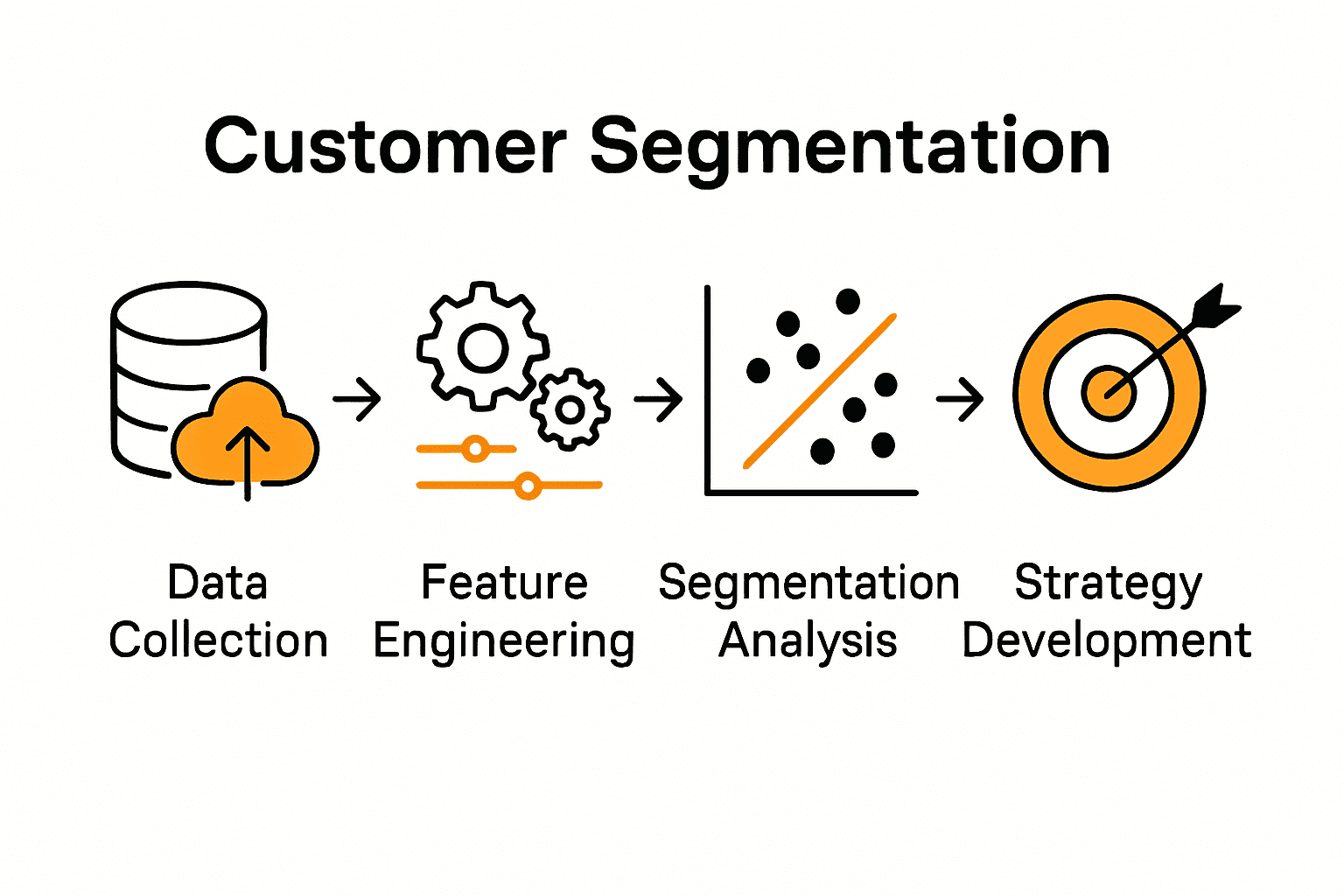
Customer segmentation is a sophisticated process that transforms raw data into actionable insights. According to recent research, the segmentation pipeline involves a comprehensive approach of data collection, customer representation, advanced analysis, and targeted strategy development. This systematic method allows e-commerce businesses to move beyond generic marketing to precision-driven customer engagement.
The key steps in the segmentation process typically include:
- Data Collection: Gathering transactional, behavioral, and demographic information
- Feature Engineering: Creating meaningful representations of customer characteristics
- Segmentation Analysis: Applying clustering techniques like k-means to identify distinct customer groups
- Strategy Development: Creating targeted marketing approaches for each identified segment
Advanced research from a 2024 master’s thesis highlights the evolving sophistication of segmentation techniques, comparing neural networks and random forests for customer analysis. These methods go beyond traditional approaches, leveraging complex algorithmic techniques to extract nuanced insights from behavioral and transactional data. Learn more about advanced segmentation examples that demonstrate how data-driven approaches can transform your marketing strategy.
Ultimately, successful segmentation is about transforming raw data into a strategic asset. By carefully analyzing customer information through multiple lenses—transaction history, engagement patterns, and predictive modeling—e-commerce businesses can create highly personalized experiences that resonate with specific customer groups, driving both customer satisfaction and business growth.
Practical Applications for Online Retailers
Customer segmentation transforms raw data into actionable marketing strategies that can dramatically improve e-commerce performance. According to real-world examples, leading companies like Amazon leverage complex data analysis to create hyper-personalized customer experiences, dynamically generating recommendations that contribute significantly to their revenue streams.
Practical applications of customer segmentation span multiple strategic areas:
- Personalized Product Recommendations: Tailoring suggestions based on individual browsing and purchase history
- Targeted Marketing Campaigns: Designing communication strategies specific to customer segments
- Pricing and Promotion Optimization: Creating segment-specific pricing and discount strategies
- Customer Retention: Developing loyalty programs that resonate with different customer groups
A 2025 academic study introduced an innovative approach of creating interpretable customer personas like “Busy Parents” or “Bargain Hunters,” demonstrating how segmentation can support everything from search functionality to personalized navigation. Learn more about e-commerce optimization strategies that can help you implement these sophisticated segmentation techniques.
The ultimate goal of customer segmentation is transforming generic interactions into meaningful, personalized experiences. By understanding the unique characteristics, preferences, and behaviors of different customer groups, online retailers can create more compelling, relevant shopping journeys that not only attract customers but build long-term loyalty and increase overall lifetime customer value.
Common Mistakes and How to Avoid Them
Customer segmentation can quickly become ineffective when approached without strategic precision. Research reveals that many e-commerce businesses fall into predictable traps that dramatically reduce the potential impact of their segmentation efforts. The most critical errors often stem from oversimplification, outdated methodologies, and a lack of comprehensive data analysis.
Common segmentation mistakes include:
- Demographic Tunnel Vision: Relying exclusively on basic demographic information
- Static Segmentation: Failing to update customer segments regularly
- Narrow Data Collection: Ignoring behavioral and transactional insights
- Inconsistent Messaging: Creating mixed communications across different channels
- Overly Broad Segments: Developing segments that are too generic to be actionable
According to expert research, the key to avoiding these pitfalls is maintaining a dynamic, multi-dimensional approach to customer segmentation. This means continuously refining your segments, incorporating behavioral data, and ensuring that your segmentation strategy aligns with specific business key performance indicators (KPIs). Explore advanced e-commerce optimization strategies that can help you develop more sophisticated segmentation techniques.
Ultimately, successful customer segmentation is an ongoing process of learning and adaptation. By staying agile, embracing data complexity, and focusing on creating truly meaningful customer insights, e-commerce businesses can transform segmentation from a static analysis into a powerful, dynamic tool for understanding and engaging their customer base.
Unlock the True Potential of Your Customer Segments with Data-Driven Insights
Customer segmentation helps you understand your customers on a deeper level but turning those insights into real growth can feel overwhelming. The challenge lies in moving beyond basic demographics to actionable strategies that boost average order value and enhance personalized marketing efforts. APUS NEST offers a powerful solution designed specifically for e-commerce leaders ready to elevate their segmentation game by uncovering hidden product relationships and sales opportunities.
Take control of your customer data today with APUS NEST, the SaaS platform that transforms your sales data into clear, actionable reports. Whether you run a Shopify or WooCommerce store, you can easily upload your sales data and receive AI-powered analysis that identifies ideal cross-sell and bundling opportunities tied directly to your unique customer segments. Don’t let valuable revenue slip away. Start with a free report to experience the benefits or unlock the full suite of insights and export features. Explore how advanced market basket analysis can sharpen your customer engagement strategies and drive measurable growth now.
Frequently Asked Questions
What is customer segmentation in e-commerce?
Customer segmentation in e-commerce is the process of dividing a diverse customer base into distinct groups based on shared characteristics, behaviors, or preferences to create targeted marketing strategies and tailored customer experiences.
What are the major types of customer segmentation models?
The major types of customer segmentation models include demographic segmentation, behavioral segmentation, psychographic segmentation, and RFM (Recency, Frequency, Monetary) segmentation, each focusing on different aspects of customer characteristics and behaviors.
How can businesses use customer segmentation effectively?
Businesses can use customer segmentation effectively by collecting and analyzing data to create targeted marketing campaigns, personalized product recommendations, and loyalty programs that cater to the specific needs and preferences of different customer groups.
What common mistakes should be avoided in customer segmentation?
Common mistakes to avoid in customer segmentation include relying solely on demographic data, failing to update segments regularly, ignoring behavioral insights, and creating overly broad segments that lack actionable insights.
Recommended
- 7 Effective Customer Segmentation Examples for E-commerce - ApusNest Blog | ApusNest
- 7 Customer Segmentation Ideas to Boost Your Sales - ApusNest Blog | ApusNest
- Master RFM Analysis to Boost E-Commerce Sales - ApusNest Blog | ApusNest
- 7 Effective Ways to Maximize Revenue in E-commerce - ApusNest Blog | ApusNest
